OpenAI Releases Dots: The New Always-On AI Agents in ChatGPT
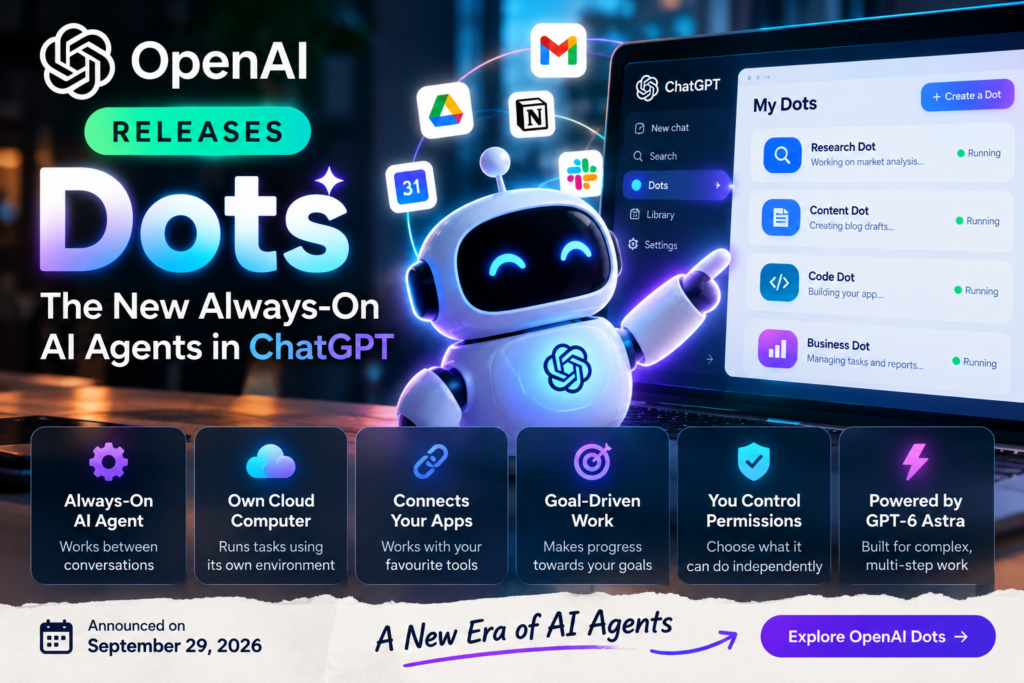
OpenAI releases Dots, a new generation of always-on AI agents designed to work on ongoing tasks even between conversations. Announced on September 29, 2026, Dots represents a major step in OpenAI’s move from traditional chat-based AI toward more proactive and autonomous digital assistants.
Unlike a normal chatbot that usually waits for a user to send a new prompt, an OpenAI Dot can be given a goal, connected to relevant apps, and allowed to continue making progress using its own cloud computer. OpenAI says users can also define what their Dot is allowed to do independently.
What Is OpenAI Dots?
OpenAI Dots are persistent AI agents inside ChatGPT. They are designed to handle ongoing work instead of completing only a single prompt at a time.
A user can give a Dot a specific goal, connect the apps required for the task, and set permissions for what actions the agent can perform. The Dot can then continue working and return results for the user to review.
OpenAI’s official release notes describe Dots as “always-on agents” that can keep making progress between conversations. They are powered by GPT-6 Astra and operate using their own cloud computer.
How Does OpenAI Dots Work?
The basic idea behind Dots is simple.
Instead of repeatedly telling ChatGPT what to do next, users can provide an ongoing objective. The Dot can then use the tools and connected applications available to it to work toward that goal.
The process generally involves:
- Giving the Dot a goal.
- Connecting the apps it needs.
- Choosing what actions it can perform on its own.
- Allowing the agent to work using its cloud environment.
- Reviewing the results it brings back.
This approach could make ChatGPT more useful for tasks that require multiple steps or need to continue over time.
OpenAI Dots Uses GPT-6 Astra
One of the most important details about OpenAI Dots is the model behind it.
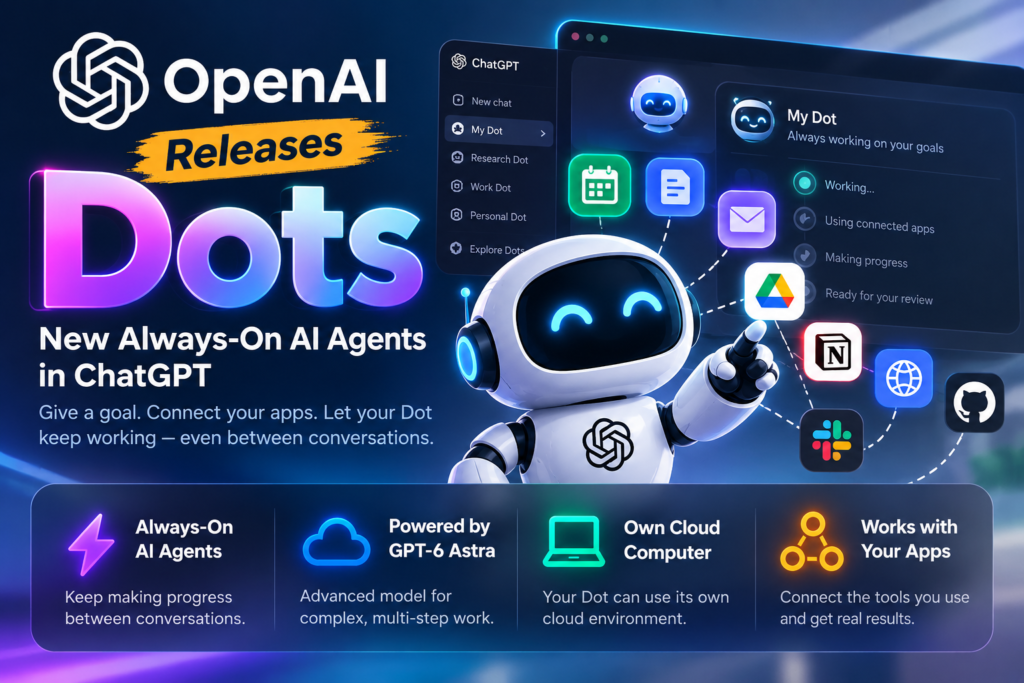
Dots are powered by GPT-6 Astra, OpenAI’s model designed for areas including coding, research, computer use and complex multi-step work. OpenAI previously introduced Astra in September 2026 as part of its push toward more capable AI systems.
Combining Astra with a cloud computer allows a Dot to go beyond simply generating text. It can potentially interact with tools and applications needed to complete an assigned objective.
What Can OpenAI Dots Do?
The most interesting part of the OpenAI Dots release is its focus on ongoing work.
Depending on the tools, permissions and connected apps available to the agent, Dots are designed for workflows where an AI assistant needs to continue progressing rather than waiting for another prompt.
Potential use cases include:
- Managing ongoing projects
- Researching information across multiple steps
- Working with connected applications
- Organizing repetitive workflows
- Handling certain administrative tasks
- Following long-term goals
- Preparing results for human review
Reuters reported that OpenAI positioned Dots as autonomous agents capable of pursuing user goals across applications, highlighting the growing industry focus on AI systems that can take actions rather than only answer questions.
OpenAI Dots vs Traditional ChatGPT
Traditional ChatGPT conversations are generally prompt-driven: a user asks something, ChatGPT responds, and another user request continues the process.
Dots change that model.
Traditional ChatGPT
Users usually provide individual prompts and interact with the assistant step by step.
OpenAI Dots
A Dot can receive a broader goal and continue making progress between conversations.
This difference could be significant because it moves AI closer to becoming a persistent digital assistant instead of only an on-demand chatbot.
Why Is OpenAI Releasing Dots?
The introduction of Dots reflects a broader shift in artificial intelligence toward agentic AI.
AI companies are increasingly developing systems that can use tools, interact with software and perform multi-step tasks with less continuous input from users.
With Dots, OpenAI is taking that concept further by combining persistent agents, GPT-6 Astra, connected applications and cloud computing.
The objective is not simply to provide an AI that answers questions, but to create an assistant capable of helping users pursue ongoing goals.
Are OpenAI Dots Autonomous?
Dots have autonomous capabilities, but OpenAI emphasizes user-defined permissions.
Users can determine what their Dot is allowed to do independently, and results can be brought back for review. This is especially important because an AI agent interacting with applications may have access to sensitive information or actions.
As AI agents become more capable, permissions, privacy, security and human oversight are likely to remain important considerations.
Why OpenAI Dots Could Be Important
The launch of Dots could represent an important change in how people use ChatGPT.
Until now, many AI interactions have followed a question-and-answer format. An always-on AI agent introduces a different workflow: users specify an outcome, while the AI continues working toward it.
If the technology develops successfully, persistent agents could become useful for professionals, businesses, developers and individual users who regularly deal with multi-step digital tasks.
OpenAI Dots Release Date
OpenAI introduced Dots on September 29, 2026.
The company announced the feature in its ChatGPT release notes under the heading “Meet your dot.”
The announcement is part of a broader expansion of OpenAI’s agent-based products and AI tools.
Frequently Asked Questions About OpenAI Dots
What is OpenAI Dots?
OpenAI Dots are always-on AI agents in ChatGPT that can work toward ongoing goals and continue making progress between conversations.
When did OpenAI release Dots?
OpenAI introduced Dots on September 29, 2026.
Which AI model powers OpenAI Dots?
OpenAI Dots are powered by GPT-6 Astra.
Can OpenAI Dots work automatically?
Dots are designed to perform ongoing work, while users can define what the agent is permitted to do independently.
Does an OpenAI Dot have its own computer?
According to OpenAI, a Dot has its own cloud computer that it can use while working toward a user-defined goal.
Is OpenAI Dots different from ChatGPT?
Dots operate within the ChatGPT ecosystem but are designed as persistent agents. Instead of only responding to individual prompts, they can continue working toward an ongoing goal.
Final Thoughts
OpenAI releases Dots at a time when the AI industry is moving rapidly from conversational chatbots toward autonomous and persistent AI agents.
Powered by GPT-6 Astra, equipped with a cloud computer and designed to work with connected apps, Dots could change how users delegate digital work to ChatGPT.
The key difference is persistence: instead of starting every task from a new prompt, users can give a Dot an objective and allow it to keep making progress.
As OpenAI expands the technology, Dots could become an important part of the next generation of AI-powered personal and professional workflows.